
eThekwini Municipality’s proactive strategies for climate change disaster management

The eThekwini Municipality has developed and implemented strategies and achievements in disaster management, specifically targeting climate change-related disasters, following numerous such events in the area.
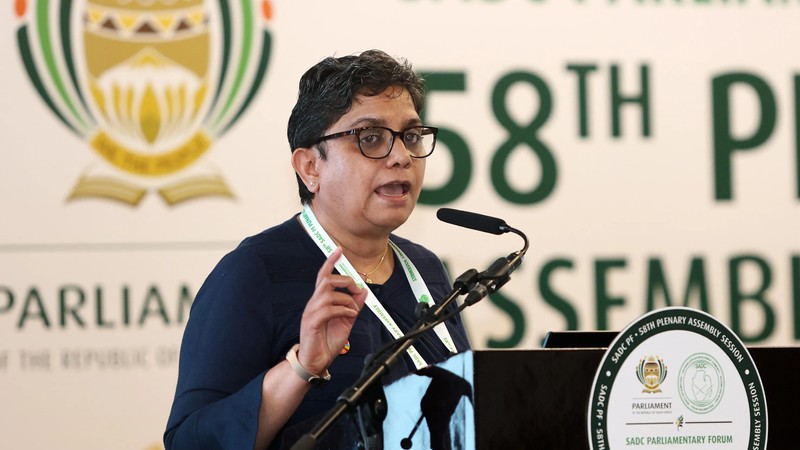
Dr Roshini Bob, Project Executive for the eThekwini Municipality Public Safety Department, stated that the municipality is well-acquainted with major, climate change-related disasters.
Although the effects have been observed and felt over a period of years, these major disasters have notably increased in frequency since 2017.
Bob was speaking at the Southern African Development Community Parliamentary Forum (SADC PF) Symposium of the 58th Plenary Assembly on Monday.
“Our Disaster Management Level 2 Plan culminated in the output from our lessons learnt, and we are happy to say that it was adopted by the council, and now the implementation process starts,” Bob explained.
“In the Level 2 Plan, there are concentrated areas such as doing disaster risk assessments concentrating on disaster reduction strategies, to make sure that we have efficient and effective responses, and to also look at coordination and collaboration effectively, because it is an all-of-government approach, it’s multidisciplinary, but it also introduces community and civil society in the space, it has to be done in an organised way.
“Thereafter, monitoring and evaluation of what we do and the respective implementations of that… The Level 2 Plan has 16 areas of concentration.”
Bob said that also included in the city is the Municipal Forum for Climate Change, which has four themes:
- Enabling,
- Cross-cutting,
- Mitigation, and
- Adaptation.
She explained that disaster management preparedness involves activating the Joint Operating Centre and then the Disaster Management Centre upon receiving information.
A needs assessment is conducted to determine the impact, followed by the identification of relief sources and shelters for displaced people. Relief interventions from the government and civil society, including spiritual and religious organisations, are often coordinated by the ward councillor.
Finally, communication and alerts are issued regarding future actions and methodologies. They also have a Disaster Management Advisory Forum, business partners, academia, officials, and others in that space.
Bob said that also linked to that, they embrace the various types of social relief from government and civil society.
She explained that the South African Weather Services (SAWS) issues warnings, categorised by intensity (e.g., orange level six). This categorisation dictates the planning and coordination of disaster relief efforts from the joint operation centre, involving relevant departments. They then activate their early warning systems using various methods.
They use their WhatsApp groups, city Facebook page, radio communication, loud hailing, and SMS to all councillors. Affected people are encouraged to use the emergency services number: 031 361 0000.
“We are now in the process of trying to actually get a three-digit emergency services number,” Bob said.
She further explained that the eThekwini Municipality operates its own 24/7 Forecast Early Warning System (FEWS). This system integrates and cross-references data from the SAWS.
This integration allows the municipality to precisely target its communication. By constantly monitoring the global forecast system, the SAWS system, and their own real-time radar systems, they can identify the movement of weather cells. This enhanced data provides more specific information, resulting in more focused early warning systems for neighbourhoods.
Given the municipality’s large size, this improved targeting enables it to deliver loud-hailing warnings to the impacted and most vulnerable areas more quickly. Additionally, the gathered data contributes to historical information.
“Our priority projects are really to implement the disaster management risk and response Level 2 Plan. That helps us become more effective and more resilient. It’s also to include technology and insist on incident management and assessment in times of major incidents. It is also to continue to encourage and embrace stakeholders, our partners, through the Disaster Management Advisory Forum.”
She said their early warning systems have identified their high-risk areas and continue training and educating people within the area, and linked to how to embrace the early warning systems, to continue having public awareness, and to improve the relief programmes, particularly from a city perspective, to find space for relief storage.
thobeka.ngema@inl.co.za