
World AIDS Day: Major advancements in HIV treatment announced by deputy president
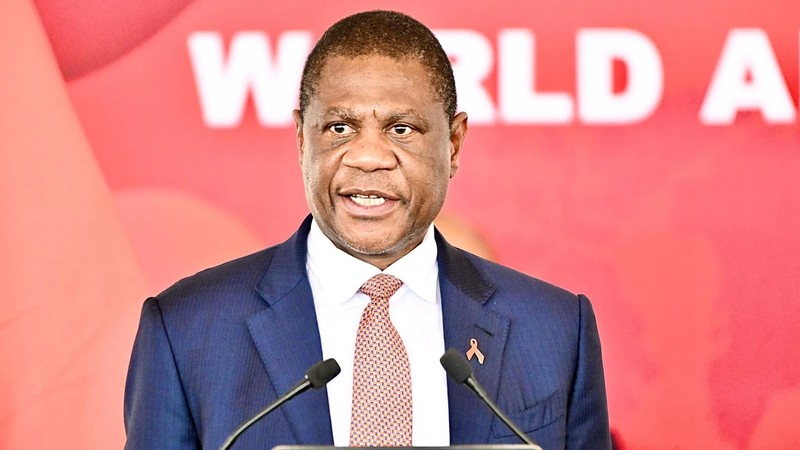

Deputy President Paul Mashatile, as well as other national and provincial leaders, celebrated the country’s progress in transforming HIV from a death sentence into a condition that can be managed with dignity and hope on World AIDS Day.
Mashatile, in his capacity as the chairperson of the South African National AIDS Council (SANAC), accompanied by Health Minister Dr Aaron Motsoaledi and leaders, for the official commemorative event at Ga-Masemola Stadium, Sekhukhune District, Limpopo.
The country continues to carry the highest burden of HIV globally, with an estimated eight million People Living with HIV (PLHIV), and about six million of them on life-saving treatment.
Over 3.5 million people living with HIV in South Africa are virally suppressed, meaning their risk of transmitting HIV to a sexual partner is almost zero.
Some of the initiatives to accelerate the response to HIV in the country include the launch of the 1.1 Million “Close the Gap HIV Treatment Campaign” to accelerate efforts toward achieving the 95-95-95 HIV targets.
The campaign seeks to identify and support the 1.1 million people living with HIV, who know their status but are not yet on treatment, addressing a critical gap in the country’s HIV response.
The country also launched the national rollout of the Six Multi-Month Dispensing (6MMD) programme to enable stable and eligible HIV patients to receive a six-month supply of antiretroviral medication, meaning they will only be required to visit a clinic twice a year.
Speaking from Limpopo, Mashatile stated that the annual observance of World AIDS Day is more than a mere formality; it is a critical opportunity to both remember those who have passed away and to renew our commitment to honouring their lives.
South Africa’s theme for this year, ‘Renewed Efforts and Sustainable Commitments to end AIDS’, underscores the necessity of revitalising strategies for improved prevention and treatment. The annual commemoration emphasises our critical commitment to accelerating efforts to bring an end to AIDS, he said.
“It stresses the importance of long-term investment in HIV amid funding cuts and changing global priorities,” Mashatile said.
He added that efforts against HIV and Aids have achieved notable progress, including surpassing the first and third UNAIDS 95-95-95 targets, but stressed how challenges persist in initiating and retaining diagnosed individuals on treatment.
“Currently, South Africa’s statistics are at 96-80-97, while global figures stand at 95-85-92.”
He said that to confront the stubborn second 95 target, the country launched one of the most ambitious national recovery efforts on February 25, 2025, known as the 1.1 million “Close the Gap” Treatment Acceleration Campaign.
“This campaign is not merely about reaching a number; it is about restoring life, reclaiming hope, and bringing our people back into a system they drifted away from for many complex reasons.
“The 1.1 million gap in particular represents mothers who stopped treatment because transport was too costly, men who walked away after negative clinic experiences, young people who feared disclosure, and thousands who moved between provinces without continuity of care. It represents the painful truth that success in HIV is never permanent.
“However, it must be defended every single day. The Close the Gap Campaign is our national call to action.”
He called for multi-sectoral coordination to ensure that we continue to perform various community-based interventions, such as door-to-door, ward-to-ward, and district-by-district mobilisations.
He said there must be policies that directly address structural inequalities and dismantle stigma, particularly for the most vulnerable among us, referring to women and girls, people who use drugs, sex workers, and the LGBTQIA+ community.
“By prioritising equity and inclusion, we can create systems that protect and empower everyone.”
He said that 2025 marks two decades since the introduction of lifesaving antiretroviral therapy (ARVs), and how, before this policy shift in the early 2000s, HIV was a fatal disease with significant mortality, reducing life expectancy to just 54 years.
The Annual World AIDS Day commemoration is held at the Ga-Masemola stadium in the Sekhukhune district in Limpopo.
This year, South Africa’s theme of “Renewed Efforts and Sustainable Commitments to end AIDS” highlights the need to revitalise strategies to improve prevention and… pic.twitter.com/s8V6d7jEsZ
— Paul Mashatile🇿🇦 (@PMashatile) December 1, 2025
He added that the country is on the verge of a significant advancement in the prevention revolution.
“Lenacapavir is a groundbreaking long-acting prevention technology that provides 100% protection for up to six months with just one injection and requires only two injections per year, which will significantly enhance how individuals protect themselves in the next generation.
“This innovation has profound implications for South Africa.
“We collaborated with SAHPRA to achieve regulatory readiness, making our regulator the first in Africa and third globally to register Lenacapavir. Additionally, we are engaging with various stakeholders to explore local manufacturing opportunities, emphasising the importance of active participation in developing prevention tools to avoid relying on global supply chains.”
He stressed that South Africa cannot repeat the mistakes of the early ARV era, where life-saving tools reached our shores too slowly.
“This time, we move with urgency, with foresight, and with unity. Lenacapavir is not just a drug. It is a symbol of what becomes possible when science, political will, and community demand meet at the same table.
“Let us confront stigma with courage, fund research, and ensure treatment reaches everyone. This is a commitment to health, dignity, justice, and equality for all people.”
theolin.tembo@inl.co.za