
Judgment reserved as NPA seeks to appeal Omotoso acquittal
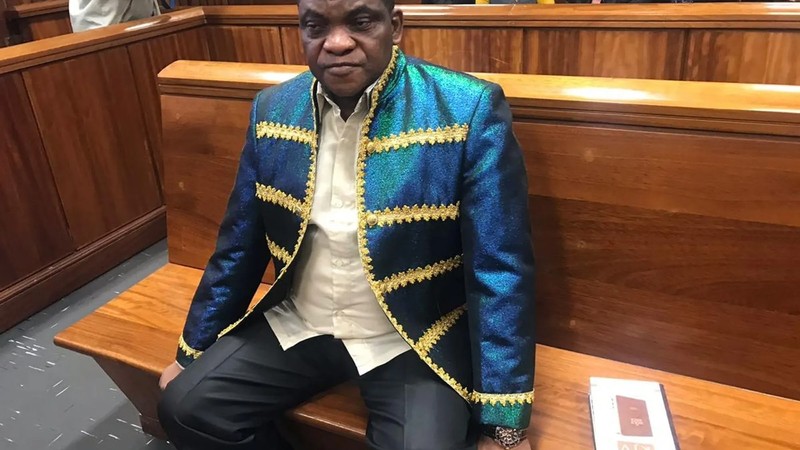


The National Prosecuting Authority (NPA) does not understand the judgment that saw Timothy Omotoso acquitted, his lawyer told the Gqeberha High Court on Monday.
Almost seven months after the Nigerian pastor and his co-accused were acquitted of 63 charges, including rape, human trafficking and racketeering, the prosecution is seeking to overturn the verdict.
The state approached the court seeking leave to appeal the acquittal to the Supreme Court of Appeal in Bloemfontein.
Before the case can go to the Supreme Court of Appeal, the NPA first has to get the high court’s permission.
Defence lawyer Peter Daubermann said the application was based on a fundamental misunderstanding of the verdict and of what counts as a factual finding in law.
Judgment in the state’s application was reserved.
Omotoso, the former televangelist who led the Jesus Dominion International Church, and his co-accused Lusanda Solani and Zukiswa Sitho were acquitted in April.
The women who brought the charges alleged sexual abuse under the guise of religious mentorship.
Judge Irma Schoeman ruled the state had failed to prove its case beyond a reasonable doubt and found several key witnesses unreliable.
The state, however, argued the case raised matters of major public interest, particularly around how courts should handle evidence when multiple complainants are involved.
It asked the court to reserve six key “questions of law” for possible appeal.
These included whether the trial court had properly assessed the evidence, made the required factual findings, and handled “similar fact” evidence — intended to show a pattern of predatory behaviour — correctly.
The state also questioned whether the court had applied the elements of racketeering properly, dealt appropriately with claims of prosecutorial misconduct, and whether some complainants’ evidence had been wrongly dismissed for lack of corroboration, though other supporting testimony existed.
Adv Apla Bodlani SC, for the state, argued the trial court did not employ the proper approach to the evaluation of evidence adduced in a criminal trial.
Bodlani cited a case that sets out how courts must weigh all evidence carefully before reaching a verdict.
Bodlani said the trial court had failed to make sufficiently clear factual findings, which “unduly curtails the already limited right of the state” to pursue an appeal under the Criminal Procedure Act.
He said the evidence pointed to a pattern of sexual exploitation that should have been treated as “similar fact evidence” to show a clear modus operandi.
Daubermann, however, strongly rejected the state’s arguments.
He told the court that the prosecution had misunderstood both the judgment and what counts as a factual finding in law.
According to him, the trial court had made clear and reasoned findings on credibility, probability, and the onus of proof.
By trying to turn disagreements over factual evaluation into questions of law, he said, the state was misreading the trial and misusing section 319.
He also pointed out that the prosecution had failed to engage with the trial record at all.
They cited no passages of evidence, no portions of testimony, and no paragraphs from the court’s judgment to support their claims, he said.
In fact, the state admitted it did not know what factual findings the trial court had made.
Daubermann said this alone made the application procedurally invalid.
Under section 319, every alleged question of law must arise from facts appearing on the record.
Without such reference, he said, the application “must fail”.
He added that the state’s so-called legal questions were, in reality, a disguised factual appeal.
“The [NPA has] failed to satisfy the jurisdictional requirements of 319 of criminal procedure act 51 of 1977 … none of the six questions advanced raises a genuine issue of law,” he said.
If the court grants the state’s request, the matter would proceed to the Supreme Court of Appeal, where a panel of judges would consider whether the trial court made errors of law.
In a separate matter, Omotoso was arrested in East London on May 10 for contravening SA Immigration Act.
The Home Affairs department had declared him a “prohibited person”, making his presence in the country illegal.
During his court appearance on May 12, however, the East London Magistrates Court ruled that authorities had failed to bring him before the courts within the prescribed 48 hours.
His detention was therefore unlawful, and he was released on a technicality.
Following his release, Omotoso filed an urgent High Court application to have his prohibited status reviewed.
The Home Affairs department expressed its intention to challenge that decision, arguing the magistrate had erred in releasing him.
Omotoso has since left the country.
IOL News