
G20: 'Africa must have greater benefit from its critical mineral resources'
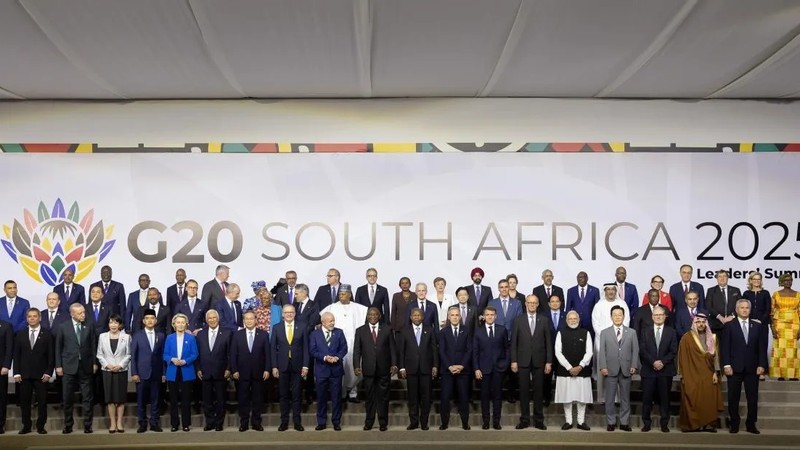


Dr Ngozi Okonjo-Iweala, the CEO of the World Trade Organisation (WTO), has challenged Africa and its leaders to strengthen their resolve and fully take charge of the vast critical minerals found on the continent.
Speaking on the sidelines of the last day of the G20 Leaders’ Summit on Sunday, Okonjo-Iweala said that for this to happen, leaders should begin to fully benefit from their minerals and create markets within the continent to create value for the vast mineral resources found on the continent.
In its 2025 summit declaration, on Saturday, the G20 leaders gathered at the Nasrec Conference and Expo Centre in Johannesburg, called for the establishment of the G20 Critical Minerals Framework (CMF), aimed at leveraging critical minerals as a catalyst for sustainable development, inclusive economic growth, and resilience.
The framework seeks to ensure that mineral-producing countries, especially those from the Global South, derive maximum benefit from their raw minerals.
On Sunday, the G20 leaders took time to engage this framework, which culminated in an extensive report on the practical ways in which Africans can take advantage of to power their economies for an equitable economic transformation.
Africa is home to approximately 30% of the world’s entire mineral reserves, with the continent having minimal benefit from its resources.
“How we position ourselves as Africa depends on us and our policy-makers. If we continue to export 60% of our commodities and raw minerals, then things will not change,” Okonjo-Iweala told members of the media on Sunday.
The global leader stated that this time around, she is hopeful that Africa is poised for change, as more and more African leaders are beginning to seek and demand change in how the continent’s critical minerals are used in production, especially in artificial intelligence.
“African leaders are saying that this has to change. South Africa has called for a G20 critical minerals framework, which I think is a great initiative. This framework is saying, let us add value to these critical minerals. We have 30% of the world’s minerals on this continent. We can go from raw mineral to finished products by creating sub-regional and regional value chains,” she stated.
Okonjo-Iweala’s remarks follow hot on the heels of a declaration by the G20 leaders, who stressed the need to harness critical minerals for inclusive economic growth for Africa and nations from the Global South.
At the weekend, South Africa was commended by more than 19 global leaders for using its G20 presidency to usher in a new era of equality and sustainability for the continent and other low-income countries.
Furthermore, these leaders committed themselves to protecting global critical mineral supply chains from “disruption”, including from geopolitical tensions, unilateral trade actions that violate World Trade Organisation rules, pandemics, or natural disasters.
“We recognise that, as the world economy is undergoing significant changes, including sustainable transitions, rapid digitisation and industrial innovations, the demand for critical minerals will increase. We note that the benefits associated with critical minerals have not been fully realised and producer countries, especially in the developing world, are confronted with challenges of underinvestment, limited value addition and beneficiation, lack of technologies as well as socio-economic and environmental issues,” the leaders said in their declaration.
Last year, during the Brazil-led G20 Summit, critical minerals were mentioned in the declaration without much fanfare, as it called for “responsible supply chains.”
This year’s draft document dedicates a four-point section to the subject, reflecting how tensions around the issue have intensified.
International relations expert Dr Oscar van Heerden said Africa finds itself very low on the value chain with regard to critical minerals, and that Ramaphosa had made it clear at the Summit that the continent was in control of 30% of the world’s critical minerals.
“That is quite a market share globally, and what they all talk about is to say, instead of sticking to the old agenda, where it is extractive and taken out of the continent, we need to turn that around and say how do we make it for ordinary Africans and make finished products.
“Critical minerals are now more needed than ever as people move into the digitised world, artificial intelligence and robotics,” said Van Heerden, adding that it was critically important that the G20 member countries discuss this issue.
“It also extends to the beneficiation means, (Africa) also needs skills, AI, robotics and digitisation,” he said.