
Fresh from 98% election win, Tanzania’s president appoints daughter and son-in-law to Cabinet
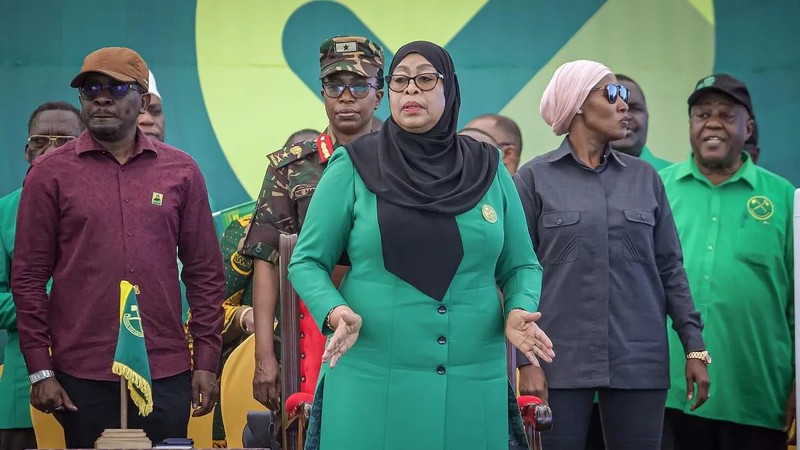


Tanzania’s President Samia Suluhu Hassan, who recently secured 98 percent of the vote in the country’s general election, has come under criticism after appointing her daughter and son-in-law to senior government positions in a sweeping post-election Cabinet reshuffle.
In the new Cabinet announced this week, the president also referred to as Mama Samia named her daughter, Wanu Hafidh Ameir, as Deputy Minister of Education, Science and Technology, and her son-in-law, Mohamed Mchengerwa, as Minister of Health.
The appointments come after the October 29 general election, which opposition parties dismissed as flawed, citing alleged irregularities and restrictions on political activity.
Wanu Hafidh, 43, is the Member of Parliament for Makunduchi in Zanzibar. Before her new appointment, she served as deputy minister in the President’s Office responsible for labour and public service management. Mchengerwa, 46, is the MP for Rufiji and previously served as Minister of Culture, Arts and Sports.
Suluhu has defended the reshuffle, which saw 27 ministers and 29 deputy ministers appointed, saying it was intended to “enhance efficiency and accountability” in government. The appointments also included several technocrats and senior Chama Cha Mapinduzi (CCM) party figures.
The reshuffle follows a controversial election in which Suluhu’s ruling party, CCM, consolidated its control of Parliament. Her near-total victory drew criticism from opposition groups and some international observers, who said the vote took place in an environment tilted heavily in favour of the ruling party.
The decision to appoint close family members to key government roles has prompted widespread discussion in Tanzania, particularly on social media platforms, with critics questioning the implications for governance and accountability. Supporters of the president argue that both appointees are elected representatives with established political careers.
Analysts say the developments could have broader implications for Tanzania’s image as one of East Africa’s more stable democracies. The country has in recent years faced growing scrutiny from civil society over political freedoms and governance standards.
jonisayi.maromo@iol.co.za
IOL News