Godongwana announces lower inflation target that could drop interest rates and boost household spending
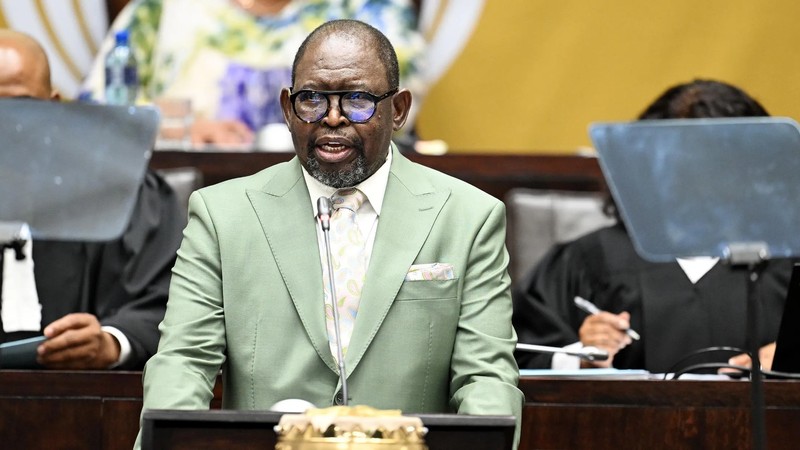


Finance Minister Enoch Godongwana on Wednesday lowered the inflation target to 3% with a one percentage point tolerance band.
Tabling the Medium Term Budget Policy Statement (MTBS), Godongwana said the revised inflation target followed an agreement between South African Reserve Bank (SARB) Governor Lesetja Kganyago and his consultations with both President Cyril Ramaphosa and Cabinet.
The new inflation target, down from between 3 and 6%, will be implemented over the next two years.
“Over time, the lower target will decrease inflation expectations and inflations, creating room for lower interest rates. This supports household spending and business investment, boosting economic growth and job creation,” Godongwana said.
Addressing journalists at a media lock-up briefing before Godongwana tabled his MTBPS, Kganyago said that he and the finance minister agreed on the new inflation target in line with South Africa’s peers.
“It is something that the Treasury and the Reserve Bank have studied for an extensive period,” he said, adding that every policy has its trade-off and that the benefits for the new target, outweigh the costs.
Tabling his the budget statement in Parliament, Godongwana said citizens have a reason to be optimistic about the future.
“Two years ago, we committed to stabilising public debt in the current year and then beginning to reduce it. Despite a challenging environment of persistently low economic growth, we are on track to achieve this goal.”
He noted that South Africa’s exiting from the Financial Action Task Force (FATF) grey list enhanced the country attractiveness to investors.
Godongwana said South Africa’s most pressing challenge remained accelerating economic growth to create jobs and reduce poverty.
“Drawing lessons from the 2025 Budget process, we have engaged extensively to build consensus on how to achieve faster growth and leverage public finances to attract the investment needed to create jobs and improve life for all.”
He said unlike in the past, revenue will exceed the budget by R19.3 billion and debt-service costs will be lower by R4.8 billion.
The minister said consolidated spending will increase from R2.6 trillion this year to R2.9 trillion in 2028/29.
“The lion’s share of consolidated non-interest spending, approximately 61% over the next three years, continues to fund the basket of government–provided services and benefits that reduce the cost of living for our citizens,” he said.
DA finance shadow minister Mark Burke described the MTBPS as a major step in the right direction.
Burke said there was much to like about the budget statement, especially with a deficit that was smaller than predicted in May and debt to GDP that was stabilising this year and then predicted to come down.
“Ideas that the DA has fought for are all over MTBPS 2025. The initial signs of a spending review culture is taking root – the first fruits are expected to save R6,7 billion,” he said.
EFF leader Julius Malema said the reduced inflation targeting was to increase borrowing and that there was no clean plan to deal with unemployment, policing and defence challenges.
“This is basically making sure they outsource that which the government is supposed to do. They are making sure that the private sector is in the right position to compete with services that should be provided for by the State,” he said.
Malema said while there was more revenue generated, it meant nothing as there was no strategy to deal with corruption.
“You can have surplus, grow the economy and have more revenue (but) in the absence of a clear strategy on how to fight corruption, it is equal to not having collected more. It means nothing,” he added.
The MK Party’s Brian Molefe said the MTBPS did mot mention how the challenges of unemployment, equality and poverty would be dealt with.
He said while the 3% inflation target was welcome, he wished that the same vigour and determination was there to deal with unemployment.
“Inflation targeting, for the vast majority of our people, is just a big word that does not have a meaning,” Molefe said.
Build One South Africa Leader Mmusi Maimane said it was good South Africa was off the FATF grey list.
“Now its hard work of all disciplines that is required to do the big things, such as cutting SETAs and agencies. When you want to make the State efficient at this point in time, we have too many agencies and SETAs that can’t deliver. It is important we focus on the growth agenda,” Maimane said.
“The challenge the minister faces is expenditure directed at citizens themselves, which is safety and policing. There was limited mention of that and I am concerned that we behave as though we have no problem of crime in the country, yet that is a big issue,” he added.
ANC economic transformation chairperson Zuko Godlimpi said the broad structure of the MTBPS was pretty much the same as the budget tabled earlier this year.
He also said GNU (Government of National Unity) partners would rally behind the budget.
“I am quite confident there will be no one who is going to break ranks on this one,” Godlimpi said.
mayibongwe.maaqhina@inl.co.za