
National declaration sought as Carletonville, Khutsong sinkholes declared a provincial disaster
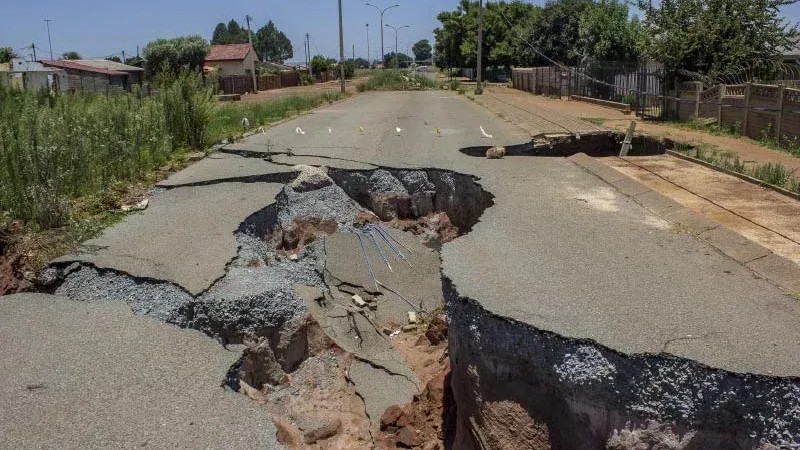


The challenge of sinkholes faced by the Merafong City Local Municipality due to the area being dolomitic has now been declared a provincial disaster, and the Gauteng government is pushing for a national disaster declaration.
National Disaster Management Centre (NDMC) head, Dr Elias Sithole, announced this week that he reconsidered previous reports submitted on sinkholes in Merafong, which include the gold mining towns Carletonville, Fochville, and Wedela, as well as townships such as Khutsong, and updated reports provided by organs of state and proposals made by the head of the Gauteng provincial DMC.
Merafong City spokesperson Thabo Moloja said the disaster declaration allows for the mobilisation of emergency funding from the provincial government.
“The provincial government has applied for the national government to declare this a national disaster to unlock additional funding, since funding remains the biggest challenge to support rehabilitation, community relief, and long-term mitigation measures,” he explained.
Moloja added that while sinkhole rehabilitation is a complex and costly engineering process, this disaster declaration ensures that Merafong City is no longer facing the challenge alone.
“We will be supported by a multi-stakeholder approach aimed at safeguarding residents, restoring infrastructure, and rebuilding our community,” he said, adding that the municipality remains committed to transparent communication with the public and will provide regular updates as projects progress.
Sithole indicated that the NDMC also assessed the potential magnitude and severity of sinkholes that formed in Gauteng, and considered the potential life safety risk some sinkholes pose to people living in the high-risk areas identified in the Council for Geoscience report.
The report stated that these parts may be exposed to sinkholes or those that may still form in the Merafong area, which may also cause damage to property, infrastructure, and the environment, as well as the potential disruption of basic services.
“I hereby give notice that in terms of Section 1 of the Disaster Management Act (DMA) of 2002 No. 57 of 2002, I regard the immediate life safety impact posed by the sinkholes as a potential disaster and hereby, in terms of Section 23(1)(b) of the DMA, I classify the disaster as a provincial disaster,” Sithole stated in a government notice published this week.
He said the primary responsibility to coordinate and manage this provincial disaster, in terms of existing legislation and contingency arrangements, is designated to the provincial executive, and called on organs of state to further strengthen their support to the existing structures to implement their contingency arrangements.
In addition, they must ensure that appropriate measures are put in place to enable the provincial executive to effectively deal with the effects of this provincial disaster.
Sithole has also recommended that the provincial executive and the respective councils implement a multisectoral relief and rehabilitation plan to deal with the effects of the provincial disaster and for each organ of state to prepare and submit progress reports, in line with the NDMC’s requirements, to monitor the response initiatives by organs of state, non-governmental organisations, and communities.
The NDMC also expects all affected organs of state to prepare and submit reports.
Just over a year ago, the Merafong Environmental Risks Community Support Group complained to Parliament that it had written letters of requests to the NDMC and Sithole for the declaration of Khutsong/Carletonville and Weldverdiend as sinkhole-prone disaster areas, as had been previously done to other areas and/or provinces.
The support group told MPs that Merafong and, in particular, Khutsong, have been and are still engulfed by the unbarricaded sinkholes for the past seven to eight years.
DA Merafong caucus leader Carlos Rebelo said fixing of five sinkholes in Carletonville and Khutsong was allocated R120 million, and it was insufficient, and the municipality received another amount between R60m and R80m from disaster management.
He said the area is on dolomitic ground, which ordinarily should not have water and sewage.
According to Rebelo, he suggested that the municipality should treat water leaks as an emergency. He added that only two of the five sinkholes were rehabilitated with the R120m allocation.
Rebelo said the Carletonville 007 reservoir does not pump any water because it is cracked, yet the municipality is constructing a pipeline before fixing the reservoir.
Merafong City’s Moloja said the provincial disaster declaration due to sinkholes unlocks the possibility of coordinated and urgent interventions from all spheres of government.
He said affected residents can expect the municipality, in collaboration with the Gauteng provincial government departments, to continue to implement a comprehensive disaster management and rehabilitation plan focusing on sinkhole-affected areas.
Moloja said geotechnical experts will continue to conduct detailed studies to determine the extent of ground instability and to prioritise areas for rehabilitation and infrastructure protection.
Additionally, critical infrastructure such as roads, electricity lines, water, and sewer networks will be stabilised and repaired where resources are available, with priority given to high-risk areas that affect service delivery and public safety, such as schools and clinics.
He promised that residents in severely affected zones will receive safety advisories, and where necessary, relocation options will be explored to protect lives, working with the provincial Human Settlements Department.
loyiso.sidimba@inl.co.za